
Searching Emanuel County Criminal Dockets
Start with the court class. Emanuel Superior Court holds felony matters. Emanuel State Court handles misdemeanors, traffic cases, and warrants within its jurisdiction. Kristin C. Hall, the Emanuel County Clerk of Superior Court, keeps Superior, State, and Juvenile filings and provides a public terminal. PeachCourt is the official electronic route listed for Emanuel Superior and State Courts, but it requires an account.
Gather the court, case number if known, party name, filing year, and desired entry. A clear Emanuel County criminal docket request helps the clerk choose the right desk and record series. Staff may explain access, but cannot give legal advice.
- Confirm the court through the Georgia E-Access directory.
- Sign in to PeachCourt for available Superior or State files.
- Check the court, filing year, and case identity before opening a result.
- Review later entries for settings, pleas, orders, and disposition.
- Call 478-237-8911 or use the clerk's terminal when the remote record is missing.
Emanuel Criminal Courts by Charge
A county name alone does not identify the right criminal docket. Superior Court has felony jurisdiction. State Court hears misdemeanors and traffic matters. Magistrate Court handles warrant applications and limited minor criminal work. Juvenile Court handles delinquency and juvenile traffic under tighter access rules. Municipal courts keep separate city traffic and ordinance dockets.
| Matter | Likely court | Custodian |
|---|---|---|
| Felony | Superior | Clerk of Superior Court |
| Misdemeanor | State | Clerk of Superior Court |
| Warrant | Magistrate | Probate/Magistrate office |
| Juvenile delinquency | Juvenile | Clerk, with restrictions |
City citations stay with the issuing municipal court unless later proceedings place the matter elsewhere. Emanuel County has no universal anonymous criminal search form.
Inside an Emanuel County Criminal Docket
A criminal docket is the chronological index of a case. Entries may identify the court, filing date, charge or count, warrant or bond event, arraignment, motion, continuance, trial setting, plea, disposition, and sentence. The live layout varies, so these are items to verify rather than promised fields. A link may open a file-stamped pleading, while another entry may only note that an event occurred.
| Case Number | The court-assigned identifier. No single public Emanuel format was confirmed, so do not assume a code such as YYYY-CR-#####. |
|---|---|
| Charge | The filed count or offense label, subject to later amendment. |
| Hearing Setting | An arraignment, pretrial event, motion hearing, or trial date. |
| Plea | The plea entry recorded by the court. |
| Disposition | The recorded result, which is not an arrest history or DDS record. |
PeachCourt and Emanuel Criminal Files
PeachCourt says many participating courts have records reaching back to 2005, but coverage varies. Registration is free. Public document retrieval can carry provider charges, while party and attorney access follow other rules. Sealed documents, adoption documents, and unexecuted proposed orders are excluded from public document access.
A blank result does not prove that a case never existed. Check the spelling, court, and year, then use the Emanuel clerk's public terminal. Older files may also have a different image and index trail because mandatory electronic filing began for newer Superior matters in 2019.
Use both routes: PeachCourt supplies remote access to available documents; the Emanuel clerk remains the source for indexing questions and the original record.
How an Emanuel Criminal Case Moves
Criminal cases do not all follow one path. A warrant or charging filing may come first. Arraignment addresses the charge and plea. Pretrial settings allow motions and scheduling. A plea or trial can lead to a disposition, followed by sentence or another order. A reset does not dismiss the charge. A bond entry is not the final result. Follow later entries until the Emanuel County criminal docket shows a filed outcome.
Docket flow: Filing › Arraignment › Pretrial › Plea or Trial › Disposition › Sentencing
The Emanuel County case lookup can help identify a matter before a copy request. Note: A recurring session does not prove that a specific case is set on that date.
Emanuel Criminal Settings Can Change
Superior Court publishes regular Wednesday sessions at 10 a.m., except the second and fifth Wednesdays and holidays. State Court sources conflict. One page says first and third Mondays at 9 a.m.; a county FAQ refers to third-Tuesday arraignments at 4 p.m. Treat both as source notes and confirm the live setting with the clerk.
Emergency orders can move hearings and deadlines. An official Middle Circuit order closed the Emanuel courthouse in January 2025 and tolled affected deadlines. Hurricane Helene orders provide another reason to check the Georgia emergency-order page and the latest docket entry.
Courts That Hold Criminal Dockets
The Clerk of Superior Court holds Emanuel Superior, State, and Juvenile filings, though those records are not equally public. The Probate/Magistrate office maintains its own warrant-related records. Each municipal clerk keeps city traffic and ordinance matters. Federal criminal cases belong to the Southern District of Georgia, not the Emanuel clerk or PeachCourt.
Emanuel County Clerk of Superior Court
125 South Main Street
Swainsboro, GA 30401
478-237-8911
Monday through Friday, 8 a.m. to 5 p.m.
The official clerk directory separates State criminal and jury work from Superior criminal and Juvenile work. Desk assignments may change, so use the main office phone.
Middle Circuit Criminal Docket Scale
Emanuel County is one of five counties in the Middle Judicial Circuit. The 2025 workload assessment reports three-year averages of 66 serious felonies, 1,354 other felonies, 17 misdemeanors, 686 probation revocations, and 2,124 defendants across the circuit. It lists two Superior judges and about 2,014 cases per judge.
These are not Emanuel-only totals. They show why a court and year help narrow a search. Exact county figures require the official ORDA dashboard or an export.
Sealed Dockets and Public Access
Georgia Uniform Superior Court Rule 21 creates a public-access baseline while allowing restriction through court procedures. Rule 21.6 covers protected identifiers and sealed filings. Juvenile matters, adoption records, family-violence material, and some ex parte filings may be withheld or redacted. A docket entry can remain visible while its document stays unavailable.
Key rule: Uniform Superior Court Rule 21 sets the access and restriction framework.
A missing page may reflect sealing, redaction, provider coverage, or a separate custodian. It is not proof of no case.
Emanuel Criminal Docket Source Image
The official Emanuel County family-violence page documents a local route for protective-order information related to criminal and civil court work.
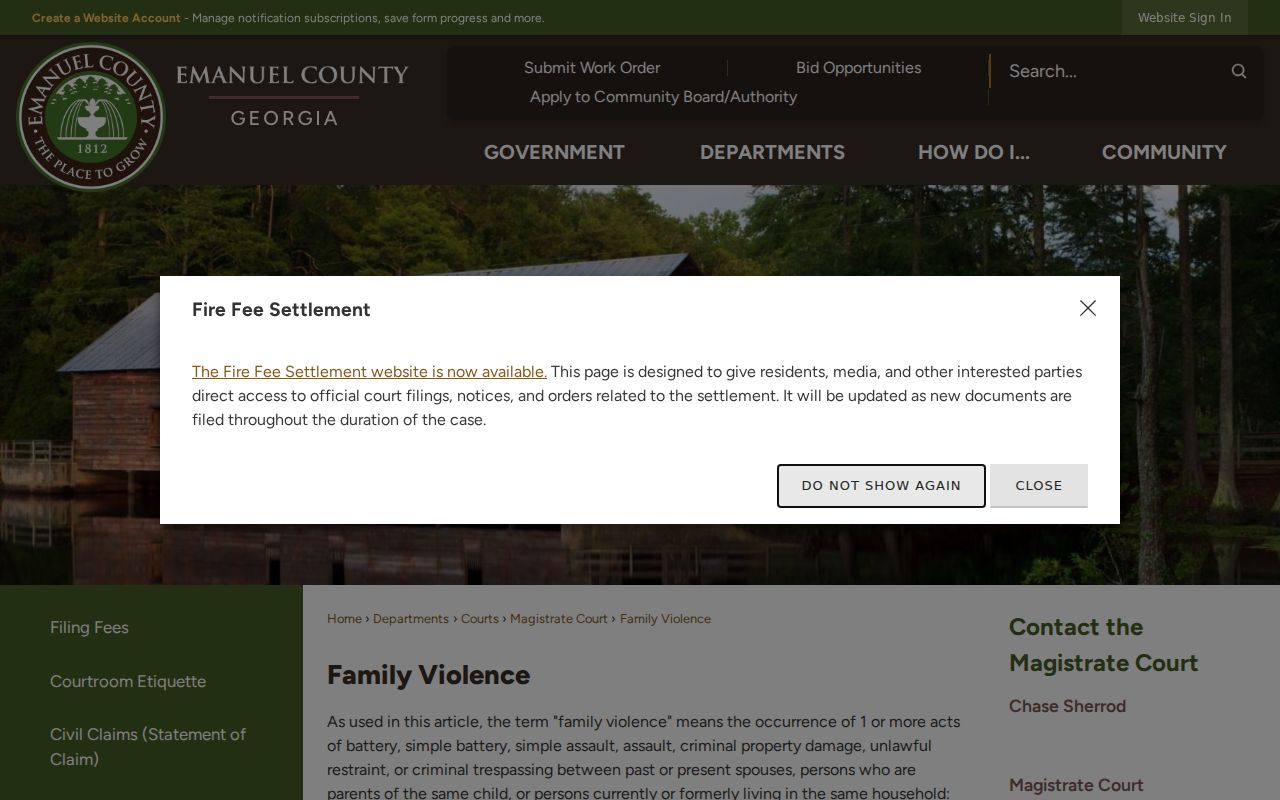
The county page reinforces the access boundary: sensitive filings may follow special procedures and should be requested from the court that holds them.
A person following an Emanuel County criminal docket should record each setting date, the source, and the time it was checked. An arraignment, pretrial setting, plea, trial, and sentencing are different events. A later continuance or emergency order can displace an earlier date without ending the case. When a public entry is abbreviated, ask the Clerk what record can be viewed or copied instead of guessing at the legal effect.
Criminal docket research also stays separate from arrest records and the DDS traffic reporting system. The court docket records the judicial case. A DDS aggregate report measures court reporting activity and errors, not the complete criminal file. Keeping those sources distinct prevents a disposition, arrest, and driver record from being treated as the same thing.
Confirm an Emanuel Criminal Docket
Before relying on an Emanuel County criminal docket, compare the case number, court class, and latest dated entry. Ask the Clerk whether a later order, reset, or restricted filing changes what the public screen shows. For State or Superior matters, the courthouse terminal and PeachCourt are complementary routes; neither should be treated as a substitute for the originating court's certified record.